Raised Audit Exemption Thresholds Are Reshaping UK Audit Portfolios: What Comes Next for Practices.


MYCPE ONE outlines how UK accounting firms can protect audit margins, redeploy capacity, and build advisory revenue as more clients fall out of statutory audit scope
LONDON, United Kingdom, [October 07, 2026] – The UK’s raised company size thresholds are changing the shape of audit portfolios across the country. For financial years beginning on or after 6 April 2025, a company can generally claim audit exemption as a small company if it meets two of these three tests: turnover of £15 million or less (up from £10.2 million), a balance sheet total of £7.5 million or less (up from £5.1 million), and no more than 50 employees. Government estimates suggest around 132,000 entities move into a smaller size band.
For UK accounting and audit practices, the effect is now visible in client portfolios. Mid-tier audit clients that once provided steady, recurring fees are reassessing whether they still need an audit. Practices face a choice: absorb the lost revenue, or reshape their audit and assurance model.
MYCPE ONE, a provider of offshore staffing and continuing education for accounting professionals, believes the firms that do well will treat this as a capacity reset, not just a revenue loss.
What the Threshold Changes Mean for UK Audit Portfolios
The uplift of roughly 50% across micro, small, and medium thresholds has three direct effects on practices:
• Fewer mandatory audits in the lower mid-market. Companies that sat just above the old £10.2 million turnover line can now often claim exemption under Section 477 of the Companies Act 2006.
• Audit work moving up-market. The medium-sized band now runs to £54 million turnover and £27 million balance sheet. Remaining statutory audits are larger and more complex, with higher documentation and quality-management demands.
• More voluntary and non-statutory assurance. Exemption does not end demand for assurance. Lenders, grant providers, investors, and shareholders holding 10% or more of shares can still require an audit. Many clients will also want limited-scope reviews or agreed-upon procedures instead.
There is also a timing factor. The FRS 102 amendments, effective for periods beginning on or after 1 January 2026, bring most operating leases onto the balance sheet. For some lease-heavy clients, this could push gross assets back toward the £7.5 million threshold, making size reassessment an annual task rather than a one-off check.
What Comes Next for UK Practices
MYCPE ONE recommends that UK firms act on four priorities over the next 12 to 18 months:
1. Re-map every audit client against the new thresholds. Confirm size classification, group status, and any contractual or shareholder audit requirements before engagement letters are renewed.
2. Repackage assurance for exempt clients. Convert lost statutory audits into voluntary audits, independent reviews, or lender-focused assurance where there is a commercial case.
3. Redeploy senior auditors to higher-value work. Use freed partner and manager time on larger audits, advisory, transaction support, and ESG or sustainability readiness.
4. Rebuild the delivery model. With lower audit volume but higher complexity per file, fixed in-house team costs become harder to justify. A flexible blend of onshore reviewers and offshore audit staff lets firms scale capacity up or down without carrying idle headcount.
How Offshore Audit Support Fits the New Model
As audit portfolios shrink at the lower end and grow in complexity at the top, many UK firms are turning to offshore audit professionals for:
• Audit file preparation, working papers, and documentation under ISAs (UK)
• Substantive testing, vouching, and sample selection
• Financial statement drafting under FRS 102 Section 1A and full FRS 102
• Review-ready files that UK managers and Responsible Individuals can sign off
MYCPE ONE supports UK practices with offshore auditing and assurance services. Offshore professionals trained in UK audit standards and practice software work as an extension of the firm’s in-house team, while engagement-level responsibility stays with the UK firm. This allows practices to keep margins on remaining audits and move partner time into advisory.
MYCPE ONE supports accounting and finance professionals worldwide through continuing professional education and offshore staffing services. Its offshoring division provides dedicated accountants, bookkeepers, tax preparers, payroll specialists, and auditors to firms in the UK, US, and Canada, with data security and compliance controls built into every engagement.
Media Contact
Nemin Vora,
Content & Media Manager, MYCPE ONE
+1 646-827-4348
nemin.vora@my-cpe.com


Share This Article
What's Trending?
Trending topics & tools for the CPA community
Announcing Business Valuation: Fundamentals, Techniques, and Theory
Written by leading industry experts, this book is an authoritative and comprehensive how-to guide to valuing private business enterprises.
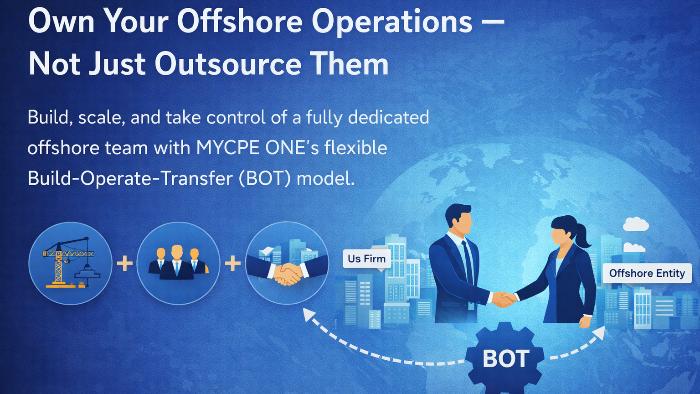
Own Your Offshore Operations — Not Just Outsource Them
Build, scale, and take control of a fully dedicated offshore team with MYCPE ONE’s flexible Build-Operate-Transfer (BOT) model.

How Firms are Rethinking Reasonable Comp (Quick Video)
It’s a short video and makes the value of repeatable, data-backed approach clear (especially compared to spreadsheets, gut checks and one-off calculations).
Resources
Valuable information provided by our sponsors.
Education & CPE: Realizing AI's Impact in Accounting Through Responsible Adoption
Becker surveyed hundreds of accounting professionals to see how they are using AI and how...
Provided By:

Effective, Hands-On Training That Fits Your Schedule and Your Budget
Save your seat in Becker’s new Open Enrollment Staff Level Training (SLT) and take part in expert-led tax...
Provided By:
CPAdirectory members have access to discounted auto and home insurance
At CPAdirectory, we think it's a good thing to provide our members with access to...
Provided By:

The accounting firms growing fastest all have this in common
Discover the billing and cash flow strategies helping firms get paid faster and grow smarter.
Provided By:
Stop Tool-Hopping: See what's new at Canopy (Plus $75)
Canopy has released massive updates to give you a truly all-in-one experience and consolidate your...
Provided By:

Free CPE-eligible Webinar: Lead Your Clients to a Successful Business
Free CPE for CPAs: Learn how to transform financial data into actionable guidance, deepen client...
Provided By: