
Canadian Accounting Firms Look to Free Up Capacity as Tariff-Hit Clients Seek Advice in 2027.

Canadian Accounting Firms Look to Free Up Capacity as Tariff-Hit Clients Seek Advice in 2027
Canada's trade dispute with the United States escalated again in late summer. In August 2026, the U.S. imposed 50% tariffs on a range of Canadian goods under Section 338, and Canada answered with counter-tariffs from September 8. For small and medium-sized businesses, the damage is now showing up in the books. Many owners are turning first to their accountant.
The challenge for Canadian CPA firms is timing. Tariff advisory work is arriving just as calendar year-end, T4 season and T1 season approach, when firm capacity is already at its tightest.
The Challenge Facing Canadian CPA Firms
Clients hit by tariffs need more than a filed return. They need rolling cash-flow forecasts, revised pricing, margin analysis by product line and help preparing applications for relief.
Federal support exists, including BDC Pivot to Grow loans of $250,000 to $5 million, announced on August 25, 2026. Applications rely on current financial statements and forecasts, which is accountants’ work.
Uptake remains low. Only 3% of small businesses surveyed by CFIB had applied for tariff relief, exemptions or remissions since August, rising to 10% among manufacturers. That gap is an advisory opportunity for Canadian firms. But the hours have to come from somewhere, and in most firms they come from the same partners and managers who review year-end files.
What the Data Shows
The Canadian Federation of Independent Business (CFIB) October 2026 Your Voice survey found that 47% of small business owners reported lower profits since August. About 30% reported a high impact from U.S. tariffs and 32% from Canadian counter-tariffs.
The pressure is uneven. Lower profits were reported by 63% of manufacturers and 60% of transportation and utilities businesses, and by 53% of owners in Ontario and 52% in Alberta. Statistics Canada's Canadian Survey on Business Conditions for the third quarter of 2026 found that 32.2% of businesses expect U.S. tariffs to hurt their operations over the next 12 months.
Accounting firms are absorbing this demand with limited staff. A Robert Half survey of Canadian finance and accounting hiring managers found that 90% had faced challenges due to a shortage of available accountants. Internationally, the 2026 Global Accounting Talent Index, covering Canada, the UK, the US and Australia, found 73% of firms turning away work.
For a firm with a manufacturing or wholesale client base in Ontario or Alberta, the arithmetic is simple. Advisory demand is rising, and the people best placed to deliver it are already fully booked.
Why Offshore Accounting Is Being Considered
The time for tariff advisory has to come out of compliance work. Many Canadian firms are using Offshore Accounting Services to move process-driven tasks off senior staff, so they can spend more hours with affected clients:
• Bookkeeping and reconciliations: including tracking duties and surtaxes paid by supplier
• Month-end and year-end close: preparing ASPE financial statements for review
• Forecast and application support: organizing historical data for cash-flow models and relief files
• Tax preparation: drafting T1, T2 and T4 filings in TaxCycle or Taxprep for reviewer sign-off
Pricing advice, financing conversations, remission strategy and engagement sign-off remain with the Canadian firm and its licensed practitioners.
Compliance and Client Data Considerations
Under PIPEDA, a firm that transfers personal information to a third party for processing remains accountable for it and must provide comparable protection through contractual or other means. Firms with Quebec clients should also account for Law 25, which requires a privacy impact assessment before personal information is communicated outside Quebec.
Engagement letters are the practical place to tell clients that information may be processed outside Canada. Record access arrangements should be reviewed against CRA books-and-records requirements, and firms should confirm specifics with their provincial CPA body or advisor.
How MYCPE ONE Can Help
MYCPE ONE works with Canadian CPA and accounting firms to add offshore tax preparation, bookkeeping and accounting capacity through dedicated offshore teams, managed offshore services and build-operate-transfer models. The aim is to move routine production work off senior staff while review and sign-off stay with the firm. As with any provider, firms should confirm access controls, security certifications and written data-protection terms before client data changes hands.
The Practical Takeaway
Tariff-hit clients will remember which adviser helped them through 2026. Firms that decide now which compliance work can move offshore will have partner hours available when clients ask for forecasts, pricing reviews and relief applications, rather than after the April 30 deadline has passed.
Media Contact
Nemin Vora,
Content & Media Manager, MYCPE ONE
+1 646-827-4348
nemin.vora@my-cpe.com
https://www.my-cpe.com


Share This Article
What's Trending?
Trending topics & tools for the CPA community
MYCPE ONE Acquires AssureOne, AI-First Tech Platform for CPA and Accounting Firms
MYCPE ONE, a partner to more than 3,000 CPA and accounting firms in United States, today announced it has acquired AssureOne, an AI-first tech platform for practice management, tax, audit and bookkeeping work. Financial terms were not disclosed.

Announcing Business Valuation: Fundamentals, Techniques, and Theory
Written by leading industry experts, this book is an authoritative and comprehensive how-to guide to valuing private business enterprises.
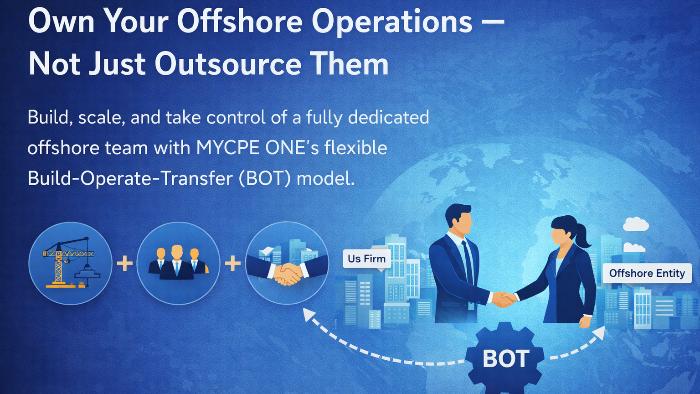
Own Your Offshore Operations — Not Just Outsource Them
Build, scale, and take control of a fully dedicated offshore team with MYCPE ONE’s flexible Build-Operate-Transfer (BOT) model.
Resources
Valuable information provided by our sponsors.
Education & CPE: Realizing AI's Impact in Accounting Through Responsible Adoption
Becker surveyed hundreds of accounting professionals to see how they are using AI and how...
Provided By:

Effective, Hands-On Training That Fits Your Schedule and Your Budget
Save your seat in Becker’s new Open Enrollment Staff Level Training (SLT) and take part in expert-led tax...
Provided By:
CPAdirectory members have access to discounted auto and home insurance
At CPAdirectory, we think it's a good thing to provide our members with access to...
Provided By:

The accounting firms growing fastest all have this in common
Discover the billing and cash flow strategies helping firms get paid faster and grow smarter.
Provided By:

Stop Tool-Hopping: See what's new at Canopy (Plus $75)
Canopy has released massive updates to give you a truly all-in-one experience and consolidate your...
Provided By:

Free CPE-eligible Webinar: Lead Your Clients to a Successful Business
Free CPE for CPAs: Learn how to transform financial data into actionable guidance, deepen client...
Provided By: